Economy in an idle game: building a factory that never goes bankrupt in Coating Factory
05.11.2026 · 3 min read
- #economy
- #game design
- #Unity
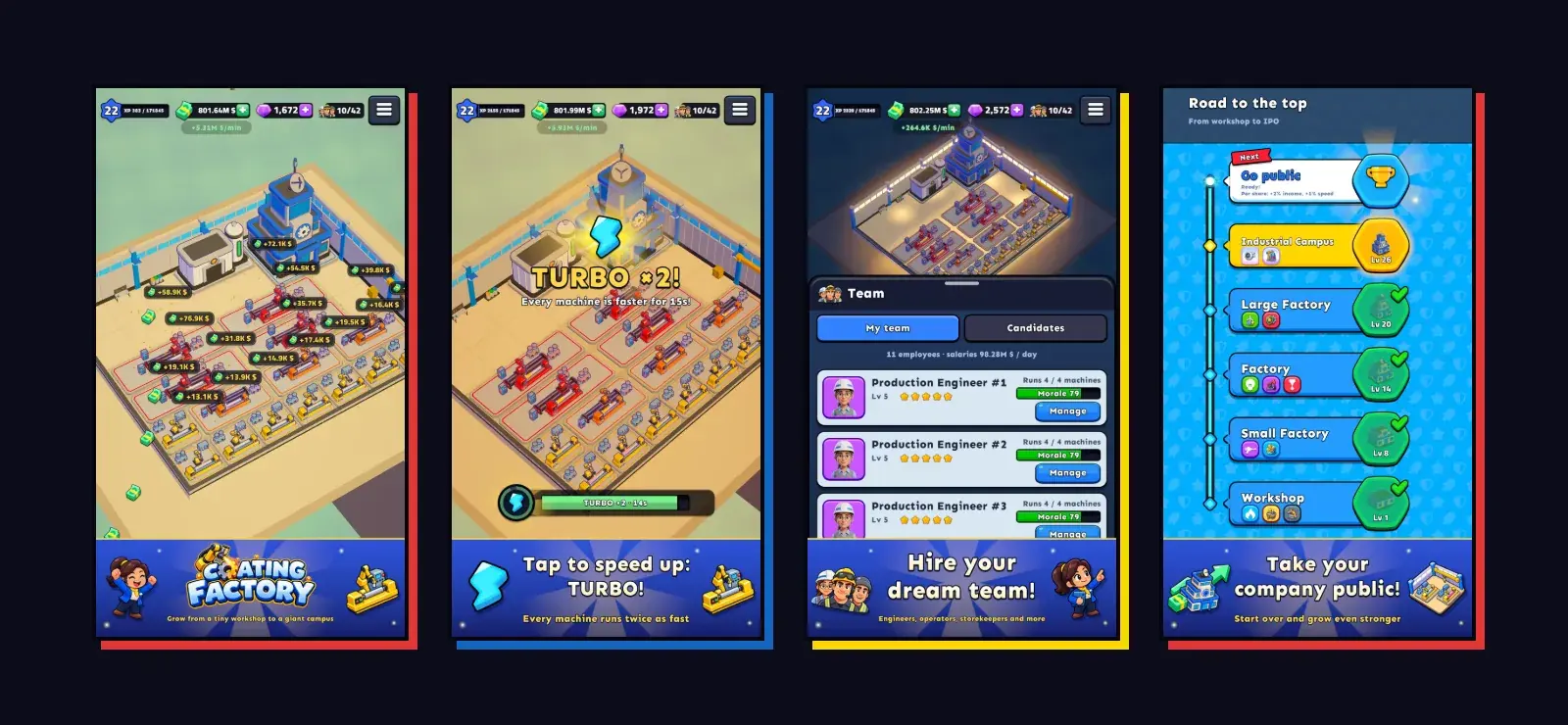
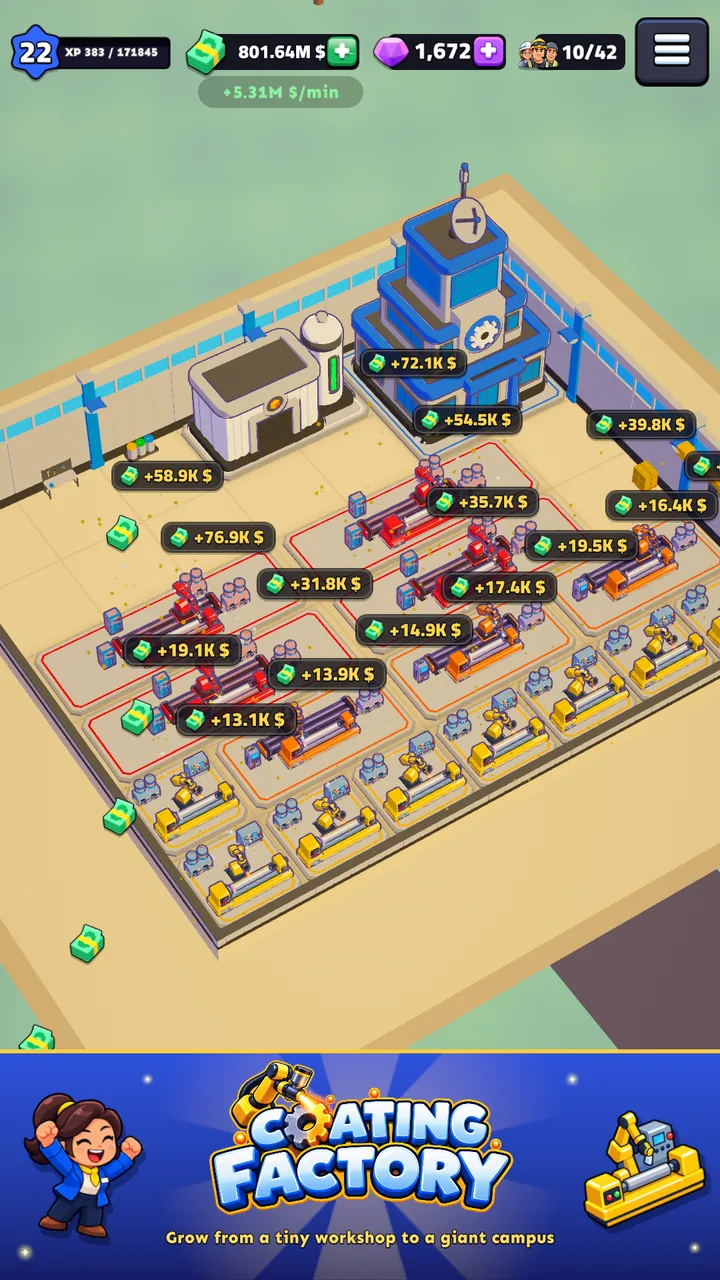
Coating Factory is an idle factory game about turning a small workshop into a large industrial coating company. Customers send real industrial parts like pump impellers, valves and turbine blades; machines coat them, and the money earned goes into upgrading machines, building a team and growing the factory. The game launched on Google Play in October 2026 in 11 languages.
In idle games, the player touches very little on screen; the real game is how the numbers grow. That's why the economy is where I spent most of my time in Coating Factory.
Every coin has an address
The first rule: every source and sink of money, gems and experience in the game is written down in one document. Job payments, rush orders, offline earnings, ad rewards, machine purchases, rent, salaries, loan interest... Each line has the formula, where its setting lives in the game, and which code calculates it.
It may sound like bureaucracy. But when a player asks "why did my money go down?", I look at this map instead of guessing. And when I change a balance value, I see in advance what it will affect.
Let the bot play
It's hard to tell whether an economy is good by playing alone; I'm just one kind of player, and I know the game too well. So I built a balance bot that plays the game as different kinds of players. At first there were three profiles: active, daily and light players. Later that grew to eight player types. Every profile plays both with and without watching ads, and there's also a paying profile. The bot plays the bank, hiring, upgrades, goals and events too.
The bot's first report was unpleasant: the first economy bankrupted players who closed the game and stepped away. Coming back to a bankrupt company is one of the worst things that can happen in an idle game.
Pressure, but no bankruptcy
After that I gave the economy one principle: business pressure, but no bankruptcy.
- Offline earnings are a real simulation. Jobs keep finishing while the player is away, and the money from finished jobs pays the costs. Cash can go down but never below zero, and unpaid days aren't written down as debt.
- Levels don't raise costs. Progress shouldn't punish the player.
- A way out of a crisis. When cash runs short, there's a crisis loan that has to be paid back.
I also wrote down the first health metrics the bot's reports are checked against: net margin should stay between 15 and 60 percent, no player profile should go bankrupt, and a meaningful purchase shouldn't take more than ten minutes of waiting.
Limits on purchases and ads
The economy also has a fairness side. The rule I set: purchases give players time and convenience, not a permanent advantage that breaks the rankings. The only exception is the monthly VIP's 25 percent income bonus. Ads work the same way: watching one saves time but gives no permanent edge. Store packs are priced by how much time they save.
The reward for starting over
Most idle games have a "start over" moment. In Coating Factory it's taking the company public: the player starts again with a new company but keeps a permanent share bonus and their level. That moment gives someone who has played for a long time the joy of fast growth again.
The most important thing Coating Factory taught me is that an economy has to be tested in the hands of different players, not on paper. I now use the same approach for level balance in Evo Squad: a bot plays every level and reports how hard each one is. The game's details are on the Coating Factory page.